marți, 30 noiembrie 2010

Tom Sharpe - Marea aspiraţie


Tom Sharpe - Marea aspiraţie
(The great pursuit)


(ro, 240pg, 1977)

Cartea, in original «The Great Pursuit», publicata in 1977, spune povestea agentului literar, Frensic, proprietarul unui nas care poate "adulmeca" un best-seller de la o posta. Intr-o zi, Frensic primeste un roman pseudo-pornografic - povestea iubirii dintre un adolescent si o femeie de optzeci de ani - si isi da seama ca i s-a oferit pe tava sansa de a da o lovitura comerciala.

Impreuna cu asociata lui, Sonia, reuseste sa-l convinga pe un autor nepublicat, destul de sarac cu duhul si legat de valorile morale ale artei literare, sa se dea drept autorul acelei carti. Lucrurile curg intr-un ritm accelerat, ritmand subiectul cu rasturnari de situatii destul de nebunesti, dupa care autorii vremurilor noastre se dau in vant.

Oricum, se vede treaba ca Sharpe cunoaste aproape la perfectie mecanismele de publicare si promovare din lumea literara, pe care stie sa le infatiseze cititorului intr-un mod cat se poate de primitor si simpatic.
Tom Sharpe satirizeaza industria editoriala, in special pe cea americana, axata pe castiguri cat mai mari si pe lovituri de imagine - nici o problema daca ele au la baza scandaluri grosolane -, dar si lumea plina de orgolii a scriitorilor si editorilor.


(Polirom, 25 ron)

duminică, 28 noiembrie 2010

Sergiu Someşan - Carte de magie


Sergiu Someşan - Carte de magie

(2001, ro, 54pg)

Prezentul volum de proza scurta este menit sa ne dea fiori si sa ne poarte printre faliile în realitate care constituie lumea fantasticului. Ghid ne este însusi autorul, care foloseste în mod curent naratiunea la persoana întâi [...] De fapt, Sergiu Somesan se joaca de-a fantasticul. El e un realist ce ne plimba masca insolitului prin fata ochilor, realizând un splendid spectacol de lumini si umbre.

joi, 25 noiembrie 2010

Richard Dawkins - The God Delusion


Richard Dawkins - The God Delusion

(2006, en, 398 pg)


Richard Dawkins, in The God Delusion, tells of his exasperation with colleagues who try to play both sides of the street: looking to science for justification of their religious convictions while evading the most difficult implications—the existence of a prime mover sophisticated enough to create and run the universe, “to say nothing of mind reading millions of humans simultaneously.” Such an entity, he argues, would have to be extremely complex, raising the question of how it came into existence, how it communicates —through spiritons!—and where it resides. Dawkins is frequently dismissed as a bully, but he is only putting theological doctrines to the same kind of scrutiny that any scientific theory must withstand. No one who has witnessed the merciless dissection of a new paper in physics would describe the atmosphere as overly polite.

(Amazon, ~11$)

marți, 16 noiembrie 2010

Victor Kernbach - Luntrea sublimă


Victor Kernbach - Luntrea sublimă


(1961,ro,259pg)

Prima vestire la noi a noii invataturi a fost romanul Luntrea sublima (1961) de Victor Kernbach (1923-1995) - "evocare fantastica" a celebrelor cataclisme "nucleare" care ar fi scufundat candva Atlantida, iar apoi ar fi nimicit biblicele cetati Sodoma si Gomora, in urma descinderii pe Terra a unei expeditii martiene. Este o carte de fictiune, insa, intr-un Epilog in care cuvantul nu mai apartine naratorului ci nedisimulat autorului, ni se dezvaluie o confuzie estetica specifica momentului, cand autorii nostri de science-fiction inca nu gaseau ca este neaparat necesar sa se distanteze liminar si literar de motivul abordat, prin interpunerea unui alter ego Actionai - "naratorul", ci dimpotriva, isi implicau cu voluptate in discurs insasi persoana civila, "eul empiric".

(Ed.Lucman 7,5 lei)

duminică, 7 noiembrie 2010

Mika Waltari - Egipteanul

Mika Waltari - Egipteanul

(777pg, ro, 1945)

Egipteanul este o impresionanta imagine a Egiptului din antichitate, cu 3000 de ani in urma, cind prabusirea imperiului faraonilor era iminenta.

Naratiunea isi poarta cititorul prin intreaga lume cunoscuta atunci – din Babilon in Creta si din Teba la Ierusalim, pivotind in jurul unei figuri memorabile: Sinuhe, personaj cu o origine misterioasa, care ajunge medicul personal al faraonului Akhenaton.

„Un roman extraordinar care tradeaza o eruditie absolut impresionanta... Nimic nu se compara cu aceasta uluitoare fresca a Egiptului antic.” (Library Journal)

Egipteanul contine toate ingredientele unui bestseller, razboaie, intrigi, povesti de dragoste si scene in care abunda violenta, mila, suferinta si moartea.” (New York Herald Tribune)

„Cititorii Egipteanului vor avea sentimentul unei lumi inspaimintator de familiare, in ciuda celor mai bine de trei milenii care s-au scurs de atunci.” (Lynda S. Robinson)

(54.95 lei librariabucuresti.com)

sâmbătă, 6 noiembrie 2010

Russ Olsen - Design Patterns in Ruby


Russ Olsen - Design Patterns in Ruby


(384pg, 2007, en)

This book provides a great demonstration of the key 'Gang of Four' design patterns without resorting to overly technical explanations. Written in a precise, yet almost informal style, this book covers enough ground that even those without prior exposure to design patterns will soon feel confident applying them using Ruby. Olsen has done a great job to make a book about a classically 'dry' subject into such an engaging and even occasionally humorous read.

(42.99$ Amazon)

vineri, 5 noiembrie 2010

Richard Dawkins - Climbing mount Improbable


Richard Dawkins - Climbing mount Improbable

(1996, 353pg, en)

Climbing Mount Improbable is a 1996 popular science book by Richard Dawkins. The book is about probability and how it applies to the theory of evolution, and specifically is designed to debunk claims by creationists about the probability of naturalistic mechanisms like natural selection producing complex organisms.

The main metaphorical treatment is of a geographical landscape, upon which evolution can only ascend in a gradual way, not being able to climb cliffs (this is known as an adaptive landscape). In the book he gives various ideas about a seemingly complex mechanism coming about from many different gradual steps, that were previously unseen.

joi, 4 noiembrie 2010

John Brunner - Victimele novei


John Brunner - Victimele novei
(Victims of the Nova)

(1989, 507pg, ro)


1. Polymath (probleme de ordin social - un Crusoe modern)
2. Răzbunătorii din Carrig (problema sclavagismului modern)
3. Depanatorii de pe Cyclops (atinge problema comerţului cu organe)

Maddalena şi Gus Langenschmidt.

luni, 1 noiembrie 2010

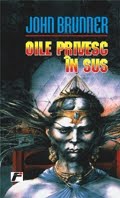
John Brunner - Oile privesc in sus


John Brunner - Oile privesc in sus
The Sheep Look Up

(1972, 334pg, ro)

Oile Privesc în sus este un roman science-fiction al scriitorului britanic John Brunner, publicat pentru prima dată în 1972. Cadrul romanului este distopic, cartea având ca subiect principal deteriorarea mediului în Statele Unite. Romanul a primit o nominalizare pentru Premiul Nebula la categoria 'Cel mai bun roman' în 1972.

Titlul romanului este un citat din poemul Lycidas de John Milton.

Odată cu ascensiunea unui guvern sponsorizat de corporații, poluarea din orașele mari a atins nivele extreme și sănătatea majorității oamenilor a fost afectată într-un fel sau altul. Romanul are mai multe planuri narative și multe personaje nu se întâlnesc unele pe altele.
În loc de capitole, cartea este împărțită în secțiuni care variază în lungime de la câteva fraze la mai multe pagini. Personajul prinicipal, Austin Train este un fost cadru universitar care, deși a prezis și interpretat schimbări sociale, devine deziluzionat de nepăsarea societății.

(Ed Rao Books, 2000, 31,60 lei)

Richard Wiseman - 59 Seconds, Think a little change a lot


Richard Wiseman - 59 Seconds, Think a little change a lot

(2009, 213pg, en)

In “59 Seconds”, psychologist Professor Richard Wiseman presents a fresh approach to change that helps people achieve their aims and ambitions in minutes, not months. From mood to memory, persuasion to procrastination, and resilience to relationships, Wiseman outlines the research supporting this new science of rapid change, and describes how these quick and quirky techniques can be incorporated into everyday life. Think a little, change a lot.

This title helps to: discover why even thinking about going to the gym can help you keep in shape; learn how pot plants make you more creative; and, find out why putting a pencil between your teeth instantly makes you happier.

duminică, 31 octombrie 2010

John Brunner - Reţelele infinitului


John Brunner - Reţelele infinitului
(The Webs of Everywhere)


(1974, 116pg, ro)

Here, Brunner deals with the broader philosophical and sociological implications of the existence of this kind of technology, whereas in the later novel he confronts it as a physics problem. Though Webs roots its story in a few assumptions that are initially a little hard to swallow — that the device, implemented without any sort of security apparatus of any kind, is singly responsible for the destruction of civilization as we know it — ultimately the tale is more thematically and intellectually rewarding.

Once the Skelter made global instantaneous travel a reality, it soon proved to have opened a Pandora's Box. Terrorists, criminals, and other miscreants used to device with impunity, wreaking havoc upon the world leading to an apocalyptic war the characters refer to as the Blowup. Not until after the dust had settled and the straggling remnants of humanity pulled themselves together did one of the world's few remaining wealthy movers and shakers, the philanthropist Chaim Aleuker, invent the privateer, that allowed Skelter owners a privacy code. It's a bit implausible, I know, that Skelters would have been built without such a device in the first place. Kind of like building a house without a door that locks.

Anyway, many years after the Blowup, we meet Hans Dykstra and Mustapha Sharif. Hans is a photographer and hobbyist who has been illegally buying Skelter codes from Mustapha, a blind Egyptian poet who has attained influence and reknown for his own philanthropic work. Hans wants a little reknown of is own, travelling to ruined cities and abandoned, forbidden territories to catalog their history; he hopes that after his own death his work will be appreciated despite its illegality. But soon ambition and greed take over Hans' altruism. One of the few men with a wife (the male/female population ratio is skewed), he is still deeply dissatisfied with his lot. Clearly a man can have what few other men have and still be miserable.

sâmbătă, 30 octombrie 2010

Arthur C Clarke - 3001: Odiseea Finală


Arthur C Clarke - 3001: Odiseea Finală
(3001: The Final Odyssey)

(1997, 149pg, ro)

3001 follows the adventures of Frank Poole, an astronaut who was deliberately killed by HAL 9000 in 2001: A Space Odyssey by casting him out into space. His body is discovered in the Kuiper belt, beyond the orbit of Neptune, by the comet-collecting space tug Goliath, after drifting in space for a millennium, and brought back to life, deep-freezing to near absolute zero having preserved him sufficiently for the advanced medical technology of the time to be able to revive him. He then explores the Earth of 3001, notable features of which are the BrainCap, a technology which interfaces computers directly with the human brain, genetically engineered dinosaur servants, a space drive, and four huge space elevators spaced around the Earth's Equator connected by a spaceport ring in geostationary orbit. Humanity has also colonized Jupiter's moons Ganymede and Callisto.

Arthur C Clarke - 2061: A treia odisee spatiala


Arthur C Clarke - 2061: A treia odisee spatiala
(2061: Odyssey Three)

(1987, 168pg, ro)

In 2061, at the age of 103, Floyd is chosen as one of several "celebrity guests" to come aboard the spaceliner Universe for the first-ever human landing on the surface of Halley's Comet, when it makes its periodic pass through the solar system. Meanwhile, a team of scientists on Ganymede are terraforming the moon. Scientist Rolf van der Berg, a second-generation Afrikaner refugee, studies pictures of Mount Zeus and determines that it is in fact one enormous diamond. He communicates his discovery to his uncle Paul Kreuger and decide that van der Berg will get aboard the Galaxy on its flyby of Europa to investigate.

As Galaxy nears Europa, a militant anti-Afrikaner USSA operative hijacks the ship forcing Galaxy to crash into Europa's ocean. She commits suicide and the rest of the crew lives stranded in their ship unable to forage, after they discover that Earth and Europan biology are incompatible. Universe receives the news that Galaxy needs rescue from Europa.

Van der Berg and Chris take the shuttle William Tsung (nicknamed Bill Tee) to study Mount Zeus, the wreck of the Chinese spacecraft Tsien, and the enormous monolith lying on its side at the border between the dayside and nightside, dubbed the Great Wall. Near Mount Zeus, van der Berg relays the message "LUCY IS HERE" to his uncle Paul, verifying that Mount Zeus is indeed one large diamond. The code word "Lucy" was chosen both in reference to the mini-sun Lucifer and to an article in the journal Nature in 1981 hypothesizing that the cores of Uranus and Neptune were in fact diamonds the size of Earth (caused by the compression of carbon), with the hypothesis making a logical extension to Jupiter. The article was subtitled "Diamonds in the Sky?" in reference to the Beatles song "Lucy in the Sky with Diamonds". Mount Zeus is a fragment of Jupiter's core which survived the creation of Lucifer and later struck Europa.

Arthur C Clarke - 2010: A doua odisee spatiala


Arthur C Clarke - 2010: A doua odisee spatiala
(2010: Odyssey Two)

(1982, 244pg, ro)

The story is set nine years after the failure of the Discovery One mission to Jupiter.

A joint Soviet-American crew, including Heywood Floyd from 2001, on the Soviet spaceship Alexei Leonov (named after the famous cosmonaut) arrives to discover what went wrong with the earlier mission, to investigate the monolith in orbit around the planet, and to resolve the disappearance of David Bowman. They hypothesize that much of this information is locked away on the now-abandoned Discovery One. The Soviets have an advanced new "Sakharov" drive which will propel them to Jupiter ahead of the American Discovery Two, so Floyd is assigned to the Leonov crew.

However, a Chinese space station rockets out of Earth orbit, revealing itself to be the interplanetary spacecraft Tsien, also aimed at Jupiter. The Leonov crewmembers think the Chinese are on a one-way trip due to its speed, but Floyd surmises that due to the large water content of Europa they intend to land there and use the water content to refuel. The Tsien's daring mission ends in failure, when it is destroyed by an indigenous life-form on Europa. The only survivor radios the story to the Leonov; it is presumed that he dies when his spacesuit air supply runs out.

Arthur C Clarke - Odiseea spatiala 2001

Arthur C Clarke - Odiseea spatiala 2001

(1968, 151pg, ro)

In the background to the story in the book, an ancient and unseen alien race uses a mechanism with the appearance of a large crystalline monolith to investigate worlds all across the galaxy and, if possible, to encourage the development of intelligent life. The book shows one such monolith appearing in ancient Africa, three million years B.C. (in the movie, this was altered to 4 million years), where it inspires a starving group of the hominid ancestors of human beings to conceive of tools. The ape-men use their tools to kill animals and eat meat, ending their starvation. They then use the tools to kill a leopard that had been preying on them; the next day, the main ape character, Moon-Watcher, uses a club to kill the leader of a rival tribe. Moon-Watcher reflects that though he is now master of the world, he is unsure of what to do next—but he will think of something. The book suggests that the monolith was instrumental in awakening intelligence, and enabling the transition of the ape-men to a higher order, with the ability to fashion crude tools and thereby be able to hunt and forage for food in a much more efficient fashion.

Arthur C Clarke - Mânia lui Dumnezeu


Arthur C Clarke - Mânia lui Dumnezeu
(The Hammer of God)


(1993, 131pg, ro)

A good portion of the book details the life of spaceship-captain Robert Singh (including his running a marathon race on the Lunar surface and uprooting his life and moving to Mars). When it is discovered that the asteroid Kali is likely to hit Earth, Singh's ship Goliath makes an emergency voyage to Kali with a load of thrusters to set up on the asteroid, hopefully nudging the rock's orbit just enough to push it clear of Earth. In the meantime, a religious sect called Chrislam, originally founded by a female veteran of the Persian Gulf War, believes that they can convert a human being into a few terabytes of computer information, and then transmit this data across space to Sirius (where they believe aliens reside); members of the sect also come to believe that the asteroid is meant to destroy the Earth. They thus sneak a bomb on board the Goliath and ruin the thrusters. While Singh uses the Goliath itself as a thruster to move the asteroid, the world government on Earth rushes to reconstruct one of the planet's long-decommissioned nuclear weapons, hoping to break the peanut-shaped Kali in two.

David Baldacci - Hour Game


David Baldacci - Hour Game

(2004, 303pg, en)

Two disgraced former Secret Service officers team up to solve a series of copy-cat crimes in this exciting new thriller by a master of the game. Sean King was momentarily distracted when a presidential candidate he'd been guarding was assassinated a few feet from where he stood, and Michelle Maxwell left the Service under a similar cloud when she lost a "protectee" to an ingenious kidnapping scheme, events told in Baldacci's typical terse, fast-paced style in Split Second.

vineri, 29 octombrie 2010

Arthur C Clarke - Leul din Comarre

Arthur C Clarke - Leul din Comarre
(Lion of Commare)


(1968,43pg,ro)

Arthur C Clarke - Insula delfinilor

Arthur C Clarke - Insula delfinilor
(Dolphin Island)


(1963, 109pg)

Late one night (in the world of the future), a giant cargo hover ship makes an emergency landing somewhere in the middle of the United States and an enterprising teenager named Johnny Clinton stows away on it. In the space of only a few hours the craft crashes into the Pacific Ocean. The crew ("even the ship's cat") is offloaded onto lifeboats, leaving Johnny (who, as a stowaway, they didn't know was on board) adrift in the flotsam from the hovercraft. His life is saved by the "People of the Sea"--dolphins. A school of these fantastic creatures guides him to an island on Australia's Great Barrier Reef. Johnny becomes involved with the work of a strange and fascinating research community where a brilliant professor (Prof Kazan) tries to communicate with dolphins. Johnny learns skindiving and survives a typhoon--only to risk his life again, immediately afterwards, to get medical help for the people on the island.

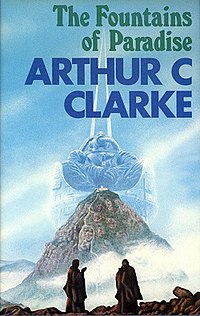
Arthur C Clarke - Fântînile Paradisului


Arthur C Clarke - Fântînile Paradisului

(The Fountains of Paradise)

(1979, 202pg, ro)

The Fountains of Paradise is a Hugo[1] and Nebula[2] Award winning 1979 novel by Arthur C. Clarke. Set in the 22nd century, it describes the construction of a space elevator. This "orbital tower" is a giant structure rising from the ground and linking with a satellite in geostationary orbit at the height of approximately 36,000 kilometers (approx. 22,300 miles). Such a structure would be used to raise payloads to orbit without having to use rockets, making it much more cost-effective.